Crossing
8 situations. Each one is drawn on the pitch in the app; the call and the rule behind it are below.
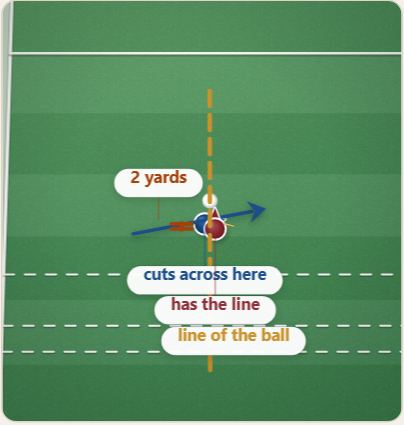
A player cuts across two yards in front, forcing the other player to check, in their own half. What is the call?
A foul. Two yards in front at speed is exactly the risk the rule is written to stop.
A player cuts across two yards in front, forcing the other player to check, in the attacking half. What is the call?
A foul. Two yards in front at speed is exactly the risk the rule is written to stop.
A player crosses five yards ahead of a player at full gallop, in their own half. What is the call?
A foul. At five yards and that speed there is plainly a risk of collision.
A player crosses five yards ahead of a player at full gallop, in the attacking half. What is the call?
A foul. At five yards and that speed there is plainly a risk of collision.
A player crosses forty yards ahead, with the ball still well behind, in their own half. What is the call?
No foul. At forty yards there is not the slightest risk, which is the test the rule sets.
A player crosses forty yards ahead, with the ball still well behind, in the attacking half. What is the call?
No foul. At forty yards there is not the slightest risk, which is the test the rule sets.
A player crosses sixty yards ahead in open field, in their own half. What is the call?
No foul. A crossing that far ahead carries no risk at all, so there is no foul.
A player crosses sixty yards ahead in open field, in the attacking half. What is the call?
No foul. A crossing that far ahead carries no risk at all, so there is no foul.
Make the call yourself
Every one of these is drawn on the pitch in the app, and you make the call before you see the answer.
Every rule here is stated in our own words, with short quoted extracts from the HPA Blue Book 2026 and Green Book 2025 and a link to the book itself. Polo Rules Test is an independent study aid and is not affiliated with the Hurlingham Polo Association. In any dispute the published rulebook governs.