Whose line is it?
25 situations. Each one is drawn on the pitch in the app; the call and the rule behind it are below.
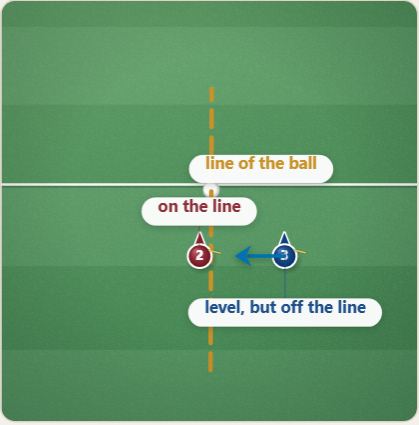
A player is following the line of the ball with it on their offside in midfield, and an opponent is level with them but off the line. Who has the right of way?
The player on the line with the ball on their offside. Rule 27b: a player on the exact line with the ball on their offside has precedence over anyone else. Being level with them off the line gives you nothing.
A player is following the line of the ball with it on their offside in the attacking third, and an opponent is level with them but off the line. Who has the right of way?
The player on the line with the ball on their offside. Rule 27b: a player on the exact line with the ball on their offside has precedence over anyone else. Being level with them off the line gives you nothing.
A player is meeting the ball on the exact line with it on their offside, and an opponent is coming to it at an angle. Who has the right of way?
The player meeting the ball on the line. Rule 27b says "whether following or meeting". Being on the exact line with the ball on your offside is what counts, not which way you are going.
Two players are following the exact line together, one with the ball on their offside and one with it on their nearside. Who has the right of way?
The player on the line with the ball on their offside. The ball has to be on your offside - your stick hand - for rule 27b. A nearside player on the same line does not take precedence from it, and rule 27h stops them playing it at all if that endangers someone who could.
Two opposing players are on the exact line of the ball, one following and one meeting, playing at each other. A third rides in at an angle. Who has the right of way?
The two on the line, over everyone else. Rule 27a: two opposing players on the exact line making a play on each other have precedence over all other players. The third must stay out of it.
Nobody is on the exact line of the ball in midfield. Two players ride for it in the same general direction, one at a shallow angle and one at a steep one. Who has the right of way?
The player riding at the lesser angle to the line. Rule 27d: with nobody on the exact line, precedence goes to the player riding at the lesser angle to it.
Nobody is on the exact line of the ball coming out of their own end. Two players ride for it in the same general direction, one at a shallow angle and one at a steep one. Who has the right of way?
The player riding at the lesser angle to the line. Rule 27d: with nobody on the exact line, precedence goes to the player riding at the lesser angle to it.
Nobody is on the exact line and two players ride for the ball at equal angles to it. Who has the right of way?
The one with the line on their offside. Rule 27d settles the tie the same way rule 27b settles the line: the ball belongs on your stick hand.
Neither player is on the exact line. One is riding the way the ball is travelling, the other is coming from the opposite direction. Who has the right of way?
The player riding the same way as the ball. Rule 27e: riding the same way as the ball has travelled takes precedence over anyone coming the other way, unless someone is on the exact line under 27a or 27b.
A player hits the ball, then rides off the exact line of it. An opponent is on the exact line. Who has the right of way?
The player on the line with the ball on their offside. Rule 27f: having hit the ball last gives you nothing once you have deviated from the exact line.
A player enters in front of the player who has the line, thirty yards ahead. Is it a foul?
No foul, if there is no risk of collision. Rule 27c lets you cross in front of the player on the line only at a speed and distance that leaves not the slightest risk of collision. Thirty yards clear is that; six yards is not.
A player enters in front of the player who has the line, six yards ahead. Is it a foul?
A foul either way. Rule 27c: entering in front of the player on the line is only allowed at a speed and distance with not the slightest risk of collision. Six yards in front of a galloping pony is not that.
A player crossed safely well in front, took the ball and is now going away with it. The player who had the line rides into them from behind. What is the call?
A foul by the player following. Rule 27c: if a player enters safely and gains control of the ball, an opponent must not ride into them from behind.
The umpire has just thrown the ball in and it has not yet left the line out. Who has the right of way?
Neither of them yet. Rule 27g: at a throw-in there is no precedence until the ball leaves the line out. Until then players may come at it from any angle, as long as they create no danger.
A player reaches across for a nearside shot, and in doing so endangers an opponent who could have made a legitimate play at the ball. Is it allowed?
No, they are not entitled to the nearside play. Rule 27h: you may not play the ball on your nearside if doing so endangers a player who would otherwise have been able to make a legitimate play.
A player is on the line with possession and the ball is unexpectedly deflected a short way and they can follow it without changing direction. What may they do?
They keep the right to play it. Rule 28a: an unexpected short deflection does not lose you the ball, as long as you can still play it without changing direction.
A player is on the line with possession and the ball is unexpectedly deflected far enough that they would have to turn for it. What may they do?
They may not turn for it, only continue a short way on the old line. Rule 28a: once you would have to change direction it is not yours. You may continue a short distance on the original line, and that is all.
The ball is deflected, and an opponent is already established on the new line of it. May the player who was on the old line play the ball?
No, not once someone is established on the new line. Rule 28a is explicit: they may not make a play on the ball if another player is established on the new line.
A player in possession suddenly changes the line of the ball into an opposing player. What is required?
The opponent must clear the new line, and be allowed to. Rule 28b(i): the opponent must clear the new line and may not make a play, but the player in possession has to allow them to clear it. Riding into them to claim a foul is itself the foul.
A player in possession with the ball on their offside moves it away at an angle to their left. What is the trailing opponent entitled to?
A nearside play only. Rule 28b(ii): the player in possession may move the ball at any angle to their left, and a trailing opponent then only has a nearside play.
A player in possession hits the ball past an opponent riding the same line at the same speed. What may that opponent do?
Play it on their offside, without crossing the player following. Rule 28c: they have the right to play it on their offside provided they do not cross the player following - and the player following must not ride into them from behind.
The first player to the ball turns in front of an opponent who is coming down the line at speed. Is it allowed?
No, you may not turn in front of a player on the line. Rule 28e: the first player to the ball may not turn in front of a player on the line of the ball.
The first player to the ball is about to turn, and the opponent coming down the line checks and slows. May they turn now?
Yes, either way, as long as they keep their speed up and play on. Rule 28e: if the player following checks or reduces speed, the first player may turn the ball either way, provided they maintain speed and continue the play.
The play is on the boards and the first player to the ball turns it. What must they then do?
Keep going in the direction they chose. Rule 28e: once a player has turned on the boards they must keep going in their chosen direction.
A player in possession is marked by an opponent within two ponies’ lengths, and slows to a walk. What are they allowed?
One tap, then hit it away or run with it inside five seconds. Rule 28d: stopped or at walking speed while marked, you may tap the ball once, and then you or a team-mate must hit it away or run with it within five seconds. The umpire may call "five seconds" or "use it".
Make the call yourself
Every one of these is drawn on the pitch in the app, and you make the call before you see the answer.
Every rule here is stated in our own words, with short quoted extracts from the HPA Blue Book 2026 and Green Book 2025 and a link to the book itself. Polo Rules Test is an independent study aid and is not affiliated with the Hurlingham Polo Association. In any dispute the published rulebook governs.